
+51 984 387 050
Sacsayhuamán Megalithic Stones are among the most extraordinary examples of Inca stonework in Peru. Located above Cusco, this monumental archaeological complex is famous for its enormous polygonal blocks, precisely fitted walls and sophisticated engineering.
This complete guide covers the history of Sacsayhuamán, the megalithic stones, construction theories, how the Incas moved the blocks, the largest stones, altitude, tickets, opening hours, tours, itinerary and frequently asked questions.
| Information | Details |
|---|---|
| Location | Cusco, Peru |
| Distance from Cusco Plaza de Armas | Approximately 2 km |
| Altitude | Approximately 3,700 m / 12,139 ft |
| Culture | Inca |
| Main development | Inca period, especially from the reign of Pachacuti |
| Architecture | Megalithic, polygonal dry-stone masonry |
| Famous feature | Three monumental zigzag walls |
| Park area | 2,997.265 hectares |
| Opening hours | 7:00 a.m.–5:30 p.m. |
| Tourist ticket | Cusco Tourist Ticket – Circuit I |
| Main nearby sites | Q’enqo, Puka Pukara and Tambomachay |
The official Dirección Desconcentrada de Cultura de Cusco identifies Sacsayhuamán as one of Peru’s most important historical-cultural spaces and records its current visiting hours as 7:00 a.m. to 5:30 p.m.
Saqsaywaman is a monumental archaeological complex located on the northern side of Cusco.
The site was much more than a simple military fortress. It was an important ceremonial, political and religious complex associated with the Inca capital.
According to the Dirección Desconcentrada de Cultura de Cusco, construction began during the government of Pachakuteq (Pachacuti) and continued under his successors, including Topa Inka Yupanqui, Huayna Qhapaq and Huáscar.
The archaeological park contains 96 archaeological sites, including Q’enqo, Tambomachay, Puka Pukara, Muyuqmarca, Rodadero and Chinkana.
Sacsayhuamán reached its greatest importance during the expansion of the Inca state.
Pachacuti transformed Cusco into a monumental imperial capital, and Sacsayhuamán became one of the most important architectural projects associated with this transformation.
The complex continued to develop under subsequent rulers. Archaeological research is still being conducted to establish the chronological sequence of its different construction phases. A research project involving the Dirección de Cultura de Cusco and the University of Warsaw has used archaeological materials and radiocarbon dating to investigate these phases.
During the colonial period, some stones from the complex were reused in buildings, churches and houses in Cusco.
This explains why the archaeological complex that visitors see today is only part of the enormous original construction.
Sacsayhuamán was declared Cultural Heritage of the Nation in 1982.
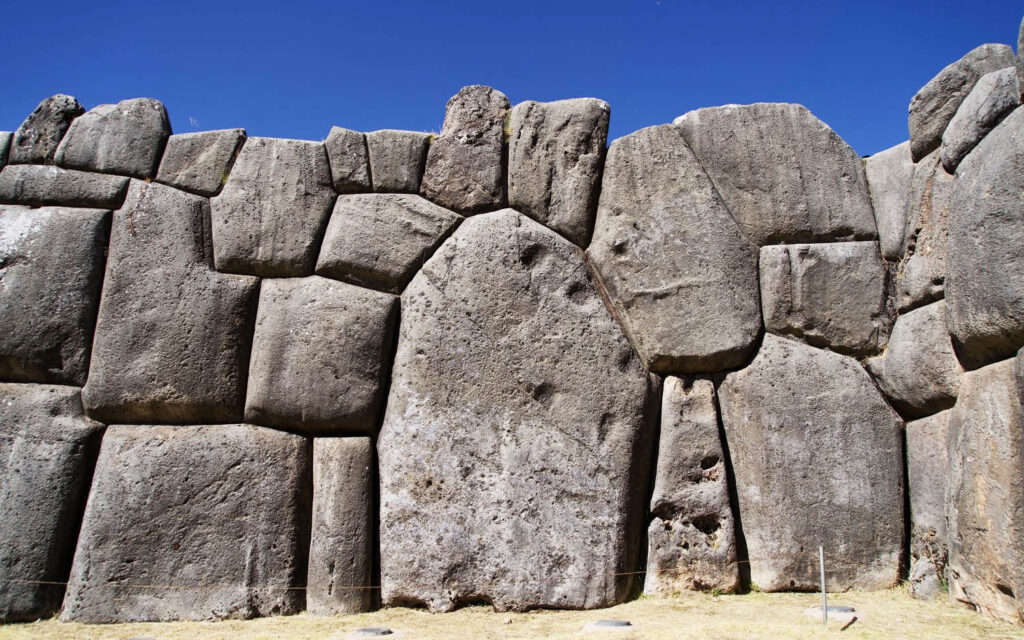
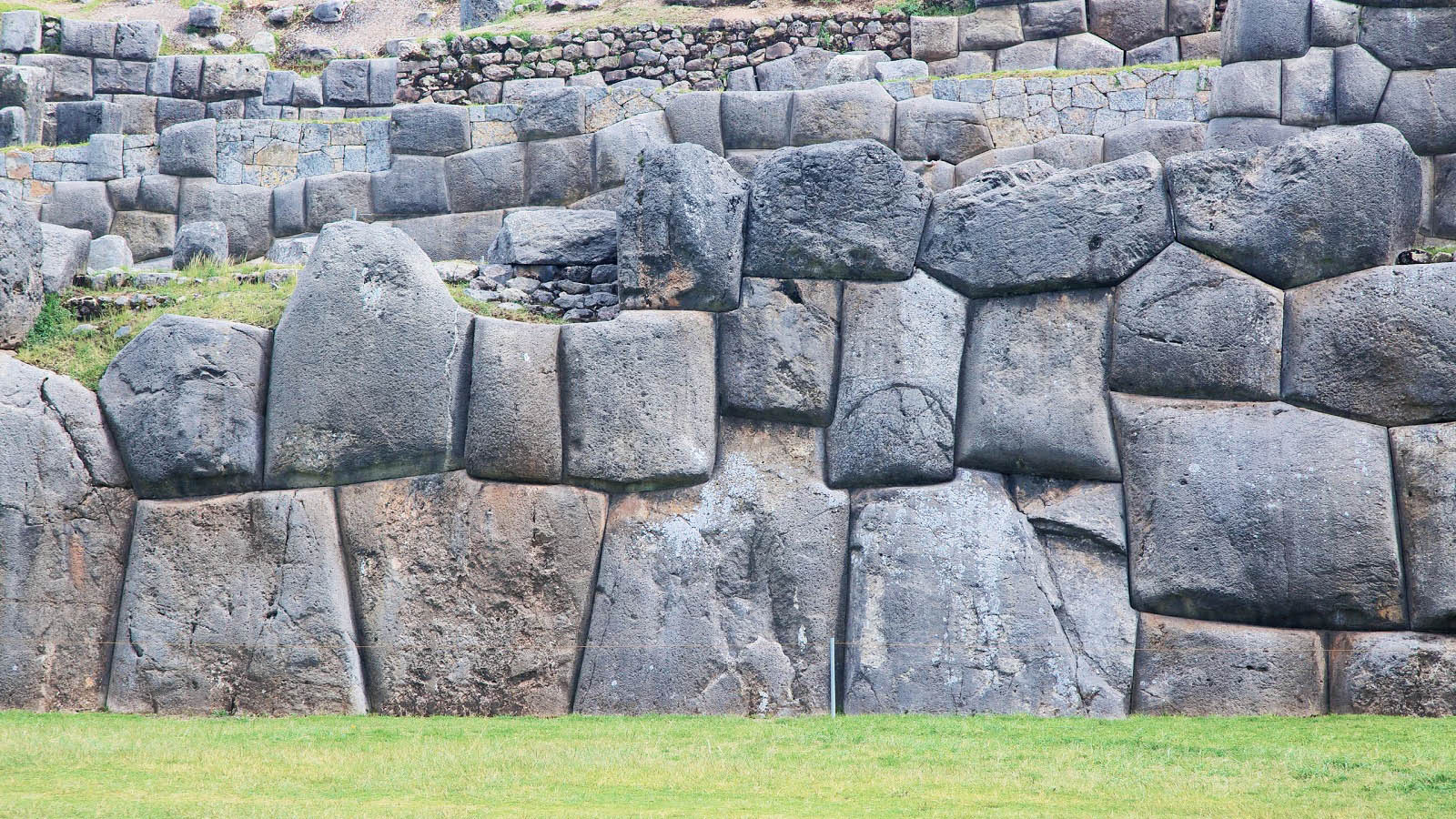
The most spectacular feature of Sacsayhuamán is its gigantic stone masonry.
The principal walls contain enormous blocks of limestone that were:
The stones are generally described as polygonal masonry, because many blocks have multiple irregular faces rather than simple rectangular shapes.
Instead of using mortar to fill large spaces between rectangular blocks, Inca builders shaped the stones so their surfaces would interlock.
This produced walls in which individual blocks act together as a structural system.
The technique is particularly effective in an earthquake-prone region such as the Andes.
Sacsayhuamán contains some of the largest stones incorporated into pre-Columbian architecture in the Americas.
According to Peru’s official tourism inventory, stones in the principal walls can reach approximately 5 meters high and 2.5 meters wide, with some estimates placing individual blocks between 90 and 125 metric tons. The same source identifies an exceptionally large block of approximately 8.5 meters high and more than 120 tons.
These measurements should be treated as estimates because the dimensions and weights of irregular archaeological blocks are difficult to determine precisely.
One of the enormous blocks in the zigzag walls is often highlighted because of its extraordinary dimensions.
Its irregular shape demonstrates that Inca builders were not simply stacking identical rectangular stones. Instead, they were creating an enormous three-dimensional stone puzzle.
This is one of the most frequently asked questions about Sacsayhuamán.
There is no single surviving construction manual explaining exactly how every block was transported and positioned.
However, archaeologists and engineers can reconstruct plausible techniques from the archaeological evidence and known Andean technologies.
1. Large labor forces
The Inca state could mobilize substantial numbers of workers for major construction projects.
2. Ropes
Strong plant-fiber ropes could have been used to pull and control heavy blocks.
3. Earthen ramps
Ramps could reduce the effective slope and allow teams of workers to move blocks gradually upward.
4. Levers
Wooden levers could help lift, rotate and adjust individual stones.
5. Stone tools
Harder stones were used in traditional Andean stoneworking to shape and finish rock surfaces.
6. Incremental positioning
Rather than lifting a 100-ton stone vertically, builders could have moved it progressively, using ramps, levers and temporary supports.
The extraordinary size of the stones does not mean that their construction requires an unknown technology.
The more scientifically defensible interpretation is that Sacsayhuamán represents an exceptional achievement in organized labor, quarrying, transportation, stone dressing and structural engineering.
There are several theories and interpretations concerning how the monument was constructed.
This is one of the most plausible explanations.
Workers could have dragged blocks along prepared surfaces using ropes while gradually raising them with ramps and levers.
The polygonal appearance suggests that each block was individually shaped to fit its neighbors.
This would explain the highly irregular but extremely tight joints.
Builders may have used wooden levers and temporary platforms to raise blocks progressively.
Rather than one dramatic lift, the process would have involved many small adjustments.
The remarkable result probably depended less on a single technological invention and more on project management and accumulated engineering knowledge.
The Inca state was capable of organizing labor, transporting materials and coordinating large construction projects over long periods.
Popular books, videos and social media sometimes claim that the stones could not have been moved by ancient Andean societies.
There is no credible archaeological evidence requiring an extraterrestrial or lost-advanced-civilization explanation.
Sacsayhuamán is extraordinary precisely because it demonstrates what ancient Andean engineers and workers were capable of achieving.
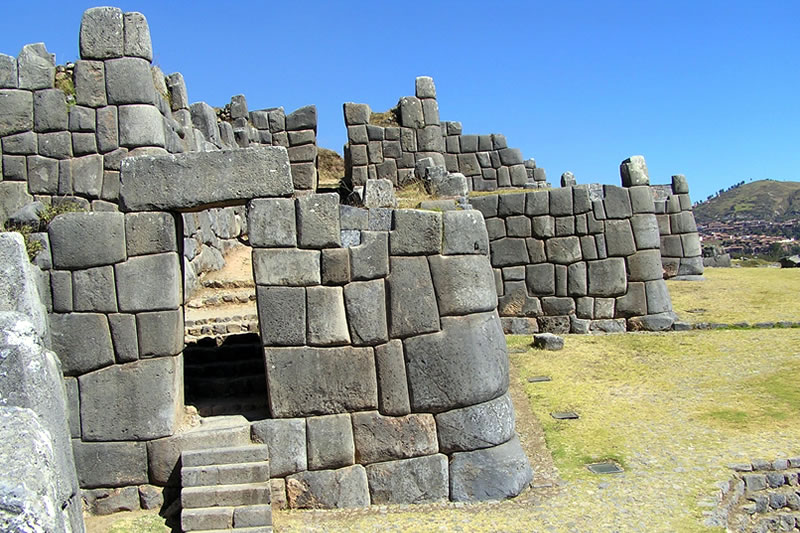
The three famous zigzag walls are probably the most recognizable feature of Sacsayhuamán.
Their geometry has generated considerable discussion.
Possible functions include:
The zigzag configuration also creates projecting and recessed sections that make the walls highly resistant and visually imposing.
The site was not simply designed as a conventional European-style fortress. Its functions were connected to the broader religious, political and urban organization of Cusco.
One important interpretation of Inca Cusco is that the city was conceived symbolically in the form of a puma.
Sacsayhuamán is commonly associated with the head of the puma.
The Dirección Desconcentrada de Cultura de Cusco describes the archaeological park as part of the symbolic concept of the “Ciudad Puma de Cusco.”
This interpretation makes the monument even more significant because its architecture was integrated into the symbolic landscape of the Inca capital.
Sacsayhuamán is located at approximately 3,700 meters (12,139 feet) above sea level.
Peru’s official tourism inventory lists an altitude of 3,700 meters.
Because Cusco itself is already at high altitude, visitors arriving from lower elevations should allow time for acclimatization.
Sacsayhuamán is included in Circuit I of the Cusco Tourist Ticket (Boleto Turístico del Cusco).
According to the current COSITUC tariff:
Circuit I includes:
The partial Circuit I ticket has 1 day of validity.
COSITUC currently lists:
Important: Ticket prices and conditions can change, so travelers should verify the current COSITUC tariff before purchasing.
The official Dirección Desconcentrada de Cultura de Cusco currently lists:
07:00 a.m. – 05:30 p.m.
For the most reliable information, check the official archaeological park information before your visit.
Sacsayhuamán is located approximately 2 km northeast of Cusco’s Plaza de Armas.
Walking from the historic center is possible, but the route involves uphill sections.
Allow approximately 30–45 minutes, depending on your starting point and pace.
A taxi is one of the easiest options if you want to conserve energy.
This is often the most convenient option because Sacsayhuamán can be combined with other important archaeological and historic attractions.
Duration: Approximately 4–5 hours
Meet your guide at your hotel or designated meeting point.
Explore the monumental zigzag walls and learn about:
Recommended time: 1–1.5 hours.
Continue to the nearby archaeological site of Q’enqo, known for its carved limestone formations and ceremonial spaces.
Visit the small fortified complex overlooking the surrounding landscape.
Finish the archaeological circuit at Tambomachay, associated with water and ceremonial fountains.
Return to your hotel or Plaza de Armas.
A practical route is:
Cusco → Sacsayhuamán → Q’enqo → Puka Pukara → Tambomachay → Cusco
This route works particularly well because all four archaeological sites are included in Circuit I of the Tourist Ticket.
For travelers interested specifically in megalithic architecture, however, it is worth spending additional time at Sacsayhuamán rather than rushing through all four sites.
Make sure your guide points out:
The principal attraction and the best place to observe the precision of Inca stone masonry.
Three enormous defensive and monumental wall terraces.
The elevated location provides excellent views over the city.
A fascinating natural-rock formation incorporated into the archaeological landscape.
An important sector of the archaeological complex associated with the monument’s upper area.
The wider archaeological park contains evidence of sophisticated water management. The official cultural authority highlights Sacsayhuamán’s hydraulic engineering and systems for collecting and distributing water.
The dry season, generally May to October, offers favorable conditions for sightseeing because there is typically less rainfall.
May–October
Advantages:
November–April
Advantages:
Disadvantages:
For a Sacsayhuamán tour, bring:
Remember that the archaeological authority prohibits climbing on or painting archaeological walls and has restrictions on food, alcohol, drones and commercial filming without authorization.
Sacsayhuamán is important because it represents the extraordinary capabilities of the Inca civilization in:
Architecture + Engineering + Stoneworking + Urban planning + Religion + Political organization
Its megalithic walls demonstrate that the Incas could coordinate enormous construction projects and manipulate extremely large stone blocks with remarkable precision.
The monument is also part of the cultural landscape of Cusco and remains an important symbol of Andean heritage.
Sacsayhuamán is approximately 3,700 meters (12,139 feet) above sea level.
Some blocks are several meters high and wide. Official tourism information reports individual stones estimated at 90–125 metric tons, with an exceptionally large block estimated at more than 120 tons.
The most plausible explanations involve organized labor, ropes, ramps, levers, temporary supports and incremental movement rather than a single lifting technique.
There is no credible archaeological evidence supporting an extraterrestrial construction theory. The monument is understood within the technological and organizational capabilities of the Inca civilization.
It has strong defensive characteristics, but scholars and Peru’s cultural authorities recognize the site as a complex with ceremonial, political, religious and architectural functions, rather than reducing it to a simple fortress.
Allow approximately 1–1.5 hours for a meaningful visit. If you are particularly interested in megalithic architecture, stoneworking and Inca engineering, 2 hours is preferable.
Yes, but a guide can add substantial historical and archaeological context, especially regarding the stonework, construction techniques and symbolism.
Sacsayhuamán is included in Circuit I of the Cusco Tourist Ticket, which also includes Q’enqo, Puka Pukara and Tambomachay.
The official cultural authority currently lists 7:00 a.m. to 5:30 p.m.
Sacsayhuamán is not simply a collection of enormous stones. It is a sophisticated archaeological complex that demonstrates the engineering, organization and architectural knowledge of the Inca civilization.
Its enormous polygonal blocks, zigzag walls and carefully engineered construction continue to fascinate visitors and researchers. Current archaeological research is also helping specialists better understand the different phases through which the complex developed.
For travelers staying in Cusco, combining Sacsayhuamán + Q’enqo + Puka Pukara + Tambomachay makes an excellent half-day archaeological experience.
